Contra Entry
A contra entry records money moving between the business's own cash and bank accounts. No customer or supplier is involved, and there is no effect on profit or loss — the money simply changes hands internally.
What it helps you do
- Record cash deposited into the bank.
- Record cash withdrawn from the bank.
- Track internal fund transfers.
- Keep cash and bank balances accurate.
Create a contra entry
Accounting → Contra Entry → + New
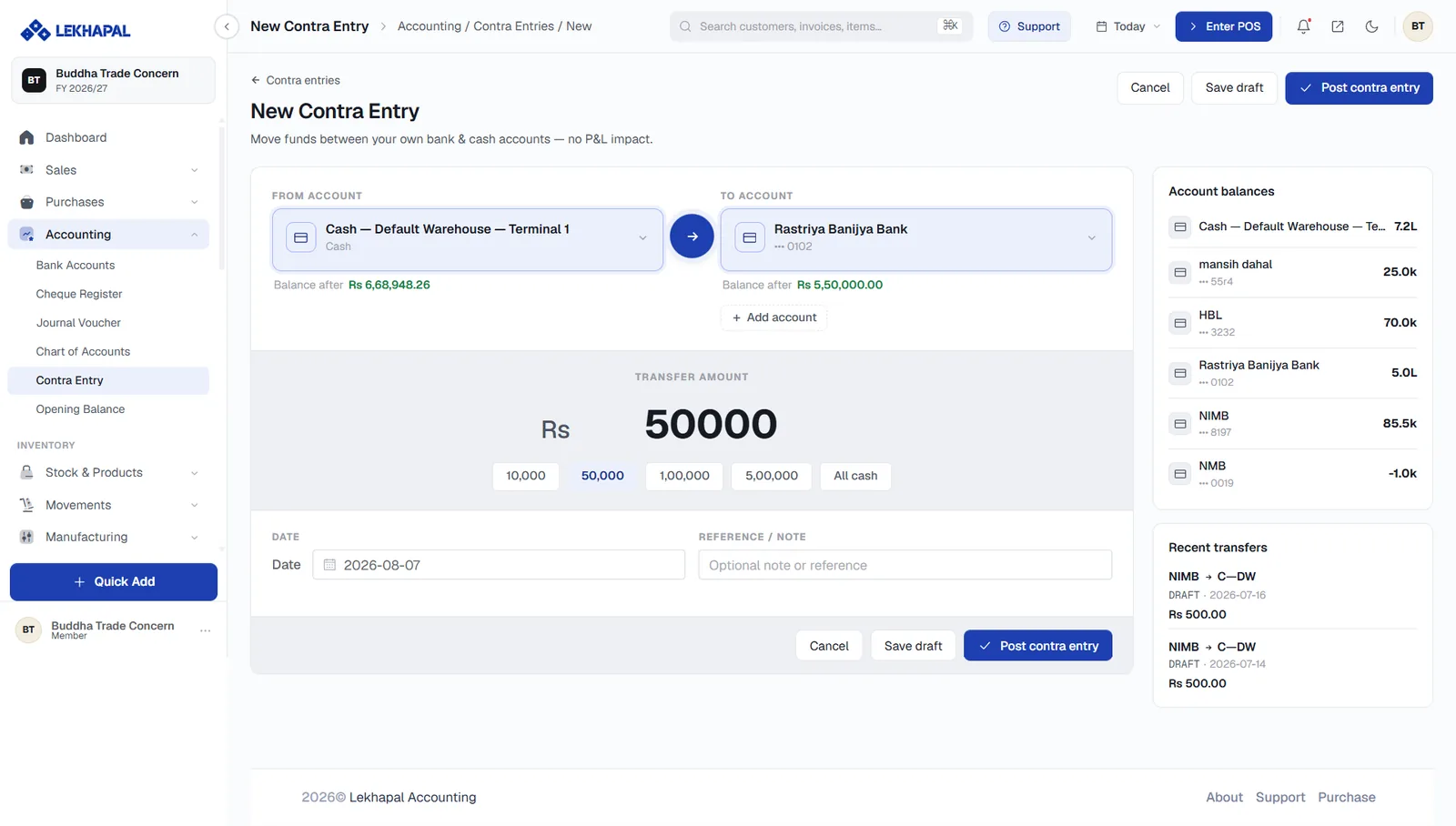
- Pick the From Account — where the money leaves. The Balance after figure under the box updates live, so you can see whether the account can stand the transfer.
- Pick the To Account — where the money lands, with its own Balance after figure. + Add account creates a new account without leaving the screen.
- Enter the Transfer Amount. Quick-amount chips — 10,000, 50,000, 1,00,000, 5,00,000 and All cash — save typing for common amounts.
- Set the Date.
- Add a Reference / Note if the transfer needs explaining.
- Click Post contra entry, or Save draft to finish it later.
The panel on the right shows Account balances across every account and Recent transfers, so you can confirm you are not duplicating a transfer someone else already made.
No profit and loss impact
The screen says so explicitly: Move funds between your own bank & cash accounts — no P&L impact. If money is leaving the business rather than moving within it, you want a supplier payment or an expense, not a contra entry.
Examples
Cash deposited into the bank
| Account | Effect |
|---|---|
| Cash | − Rs. 10,000 |
| Bank | + Rs. 10,000 |
Cash withdrawn from the bank
| Account | Effect |
|---|---|
| Bank | − Rs. 5,000 |
| Cash | + Rs. 5,000 |
In both cases the total cash position is unchanged — only its location moves.